Shop Voice
The Google Business Profile Mistakes That Quietly Cost You Calls
August 24, 2026 · Next Level Marketing Team
Most shops that complain about Google are not invisible. They show up in the map results, they have a decent star rating, and the phone still does not ring the way it should. That gap is almost never one big failure. It is a handful of small profile details that make a person on their phone hesitate for two seconds and then tap the next listing instead. Below are the ones we see most often in auto repair, home services, clinics and salons, and what to do about each.
Key takeaways
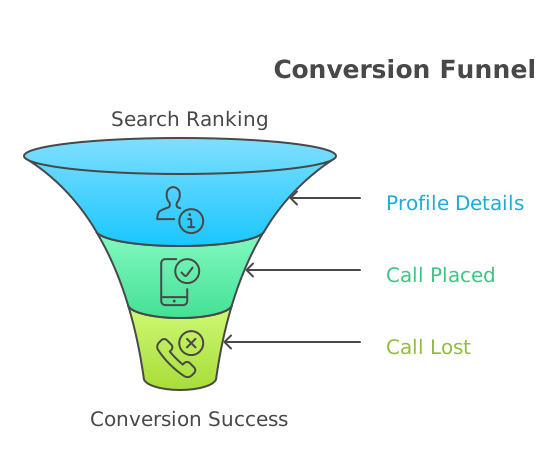
- Ranking gets you onto the screen, but small profile details decide whether someone taps call.
- An outdated phone number, tracking line, or dead voicemail is the most expensive and most common mistake.
- Hours that do not match holidays, phone availability, or the season tell customers you are closed when you are not.
- Your primary category is one of the strongest signals you control, and most owners set it once and never revisit it.
- Recent photos and recent, answered reviews are the only proof a stranger has that you exist and are competent.
Why does my profile show up but the phone stays quiet?
Showing up and getting picked are two different jobs.
Ranking gets you onto the screen. Everything after that is a snap judgment. Someone with a dead car in a parking lot or water on a basement floor is scanning three listings for reasons to trust you and reasons to move on. Blurry photos, hours that look wrong, a category that does not match what they typed, a review from last year sitting at the top with no reply from you. None of those things stop you from ranking. All of them stop the tap.
So before you spend another dollar trying to rank higher, spend an hour making sure the listing you already have earns the call.
Is your phone number sending calls to the wrong place?
This one is boring and it is the most expensive.
Check the primary phone number on your profile right now, on your actual phone, not from memory. We regularly find shops where the number on Google is an old tracking line from a marketing company they fired, a fax line, a personal cell that goes to voicemail after hours, or a number that rings a desk nobody sits at anymore.
A few things worth doing: call the number on your profile from a phone that is not in your building and listen to what a stranger hears. If you use a call tracking number, make sure it forwards correctly and that your real number is still listed somewhere consistent, like your website contact page. Make sure the voicemail greeting says your business name and gives a next step, because a default carrier greeting reads as abandoned. If you closed a second location or changed suites, make sure the old profile is not still live and collecting calls into a void.
Also worth knowing: Google has retired some of the extra communication features on Business Profiles over the years, including the built in chat and call history tools. Do not build your intake process around a Google feature. Build it around a phone line and a person or system that answers it.
Are your hours telling people you are closed when you are open?
Hours are the second quiet killer, and they fail in three ways.
First, holidays. If you do not set special hours, Google may show your normal hours or flag your listing as possibly closed, and people will not risk the drive. Set special hours for every holiday you care about, including the ones where you stay open.
Second, the difference between phone hours and door hours. Plenty of shops answer the phone at seven in the morning but do not open the bay until eight. If your profile says eight, the early caller assumes nobody is there.
Third, seasonal drift. HVAC, roofing, lawn care and clinics all change their schedule during the year and then forget to change it back. Put a recurring reminder on your calendar the same way you do for filter changes.
Does your category match the work you actually want more of?
Your primary category is one of the strongest signals you control, and most owners set it once during setup and never look again.
Two common mistakes. The first is being too broad. A shop that does mostly transmission work but lists itself only as auto repair shop is competing with everyone and specifying nothing. The second is being too narrow, where a full service shop lists a specialty category as primary and disappears from the searches that make up the bulk of its work.
The practical move is to pick a primary category that matches the job you want the most of, then add secondary categories for the rest of what you do. Then fill in the services list underneath with the real jobs in plain language, the words customers use, not the words on your invoice software.
Google publishes guidelines on how businesses may represent themselves, including rules about business names and categories. Stuffing keywords into your business name is against those guidelines and it is one of the more common reasons a competitor reports a listing. Use your real name.
Why do photos and reviews change whether someone taps call?
Because they are the only proof a stranger has that you exist and that you are competent.
On photos, the pattern that works is simple and unglamorous. Show the front of the building from the road so people can find it. Show the parking situation. Show the waiting area or the front desk. Show your team and your bays or trucks. Show a few clean examples of finished work. Skip the stock photos entirely. Someone deciding between you and the shop down the street is trying to picture walking in, and a stock image of a smiling model with a wrench tells them nothing.
On reviews, the volume matters less than the recency and the response. A profile with steady recent reviews and short professional replies from the owner reads as a business that is paying attention. A profile with great reviews that all stop two years ago reads as a business that might not be there anymore. Reply to the good ones briefly and the bad ones calmly, without arguing the details in public.
Ask for reviews as part of the job, at the moment the customer is happiest, which is usually at pickup or right after the work passes inspection.
What should I actually check, and how often?
Keep it short enough that it actually gets done.
Every month, spend fifteen minutes: call your own number from an outside phone, confirm hours including anything seasonal, reply to any new reviews, and add two or three real photos from recent work.
Every quarter, spend thirty minutes: review your primary and secondary categories against the jobs you want more of, update your services list, check that your address and service area still reflect reality, and look at your profile on a phone rather than a desktop, because that is where almost all of this gets decided.
Once a year, or any time something changes: check for duplicate listings under old names or old addresses, and confirm the person who has ownership access to the profile still works for you. Losing access to your own listing is a genuinely painful problem to unwind.
None of this is clever marketing. It is housekeeping. But housekeeping is what stands between a listing that gets seen and a listing that gets called.
Reference: Guidelines for representing your business on Google, Google Business Profile Help
Frequently asked questions
Why does my Google Business Profile show up in search but not generate phone calls?
Ranking and converting are separate problems. If your listing appears but the phone does not ring, the issue is usually in the details a customer sees at the moment of decision: an incorrect or outdated phone number, hours that suggest you are closed, a category that does not match their search, or a profile with stale photos and unanswered reviews. Fix those before trying to rank higher.
How often should a local service business update its Google Business Profile?
A light check every month and a deeper review every quarter is enough for most shops. Monthly, verify your phone number and hours, reply to reviews, and add recent photos. Quarterly, revisit your categories, services list and service area to make sure they still match the work you want.
Can I put keywords in my Google Business Profile name to rank better?
No. Google's guidelines for representing your business require your profile name to reflect your real world business name. Adding keywords or location terms that are not part of your actual name violates those guidelines and can be reported by competitors or flagged by Google, which puts the whole listing at risk.
What is the difference between a primary category and secondary categories?
The primary category is the strongest signal about what your business mainly does and carries the most weight. Secondary categories describe the additional services you offer. Choose a primary category that matches the work you most want to attract, then use secondary categories for everything else you handle.
Should I list my phone hours or my open hours on my profile?
List the hours a person can reach a human, and use the profile's more specific hour settings if your phone availability differs from your door hours. If callers are told you are closed when someone is actually answering, you lose those calls before they are ever placed.
Do photos really affect whether someone calls a local business?
They affect trust, which affects the tap. Real photos of your building, your parking, your team and your finished work help a stranger picture showing up and reduce hesitation. Stock imagery does the opposite because it signals that nobody has touched the profile recently.